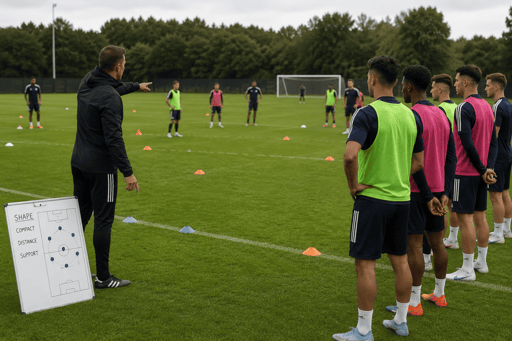
3-5-2 Formation Guide: When and How to Use It

The 3-5-2 formation gives a team three central defenders, an extra player in midfield and two genuine strikers. It can create control through the middle without losing attacking width, but only if the wing-backs understand when to advance and recover.
This guide explains when to use the system, what every position requires and how to coach effective 3-5-2 formation tactics in attack and defence.
Quick Answer: What Is the 3-5-2 Formation?
The 3-5-2 uses three centre-backs, two wing-backs, three central midfielders and two strikers. In possession, the wing-backs move high and wide, often creating a 3-2-5 attacking shape. Without the ball, they drop alongside the centre-backs to form a compact 5-3-2.
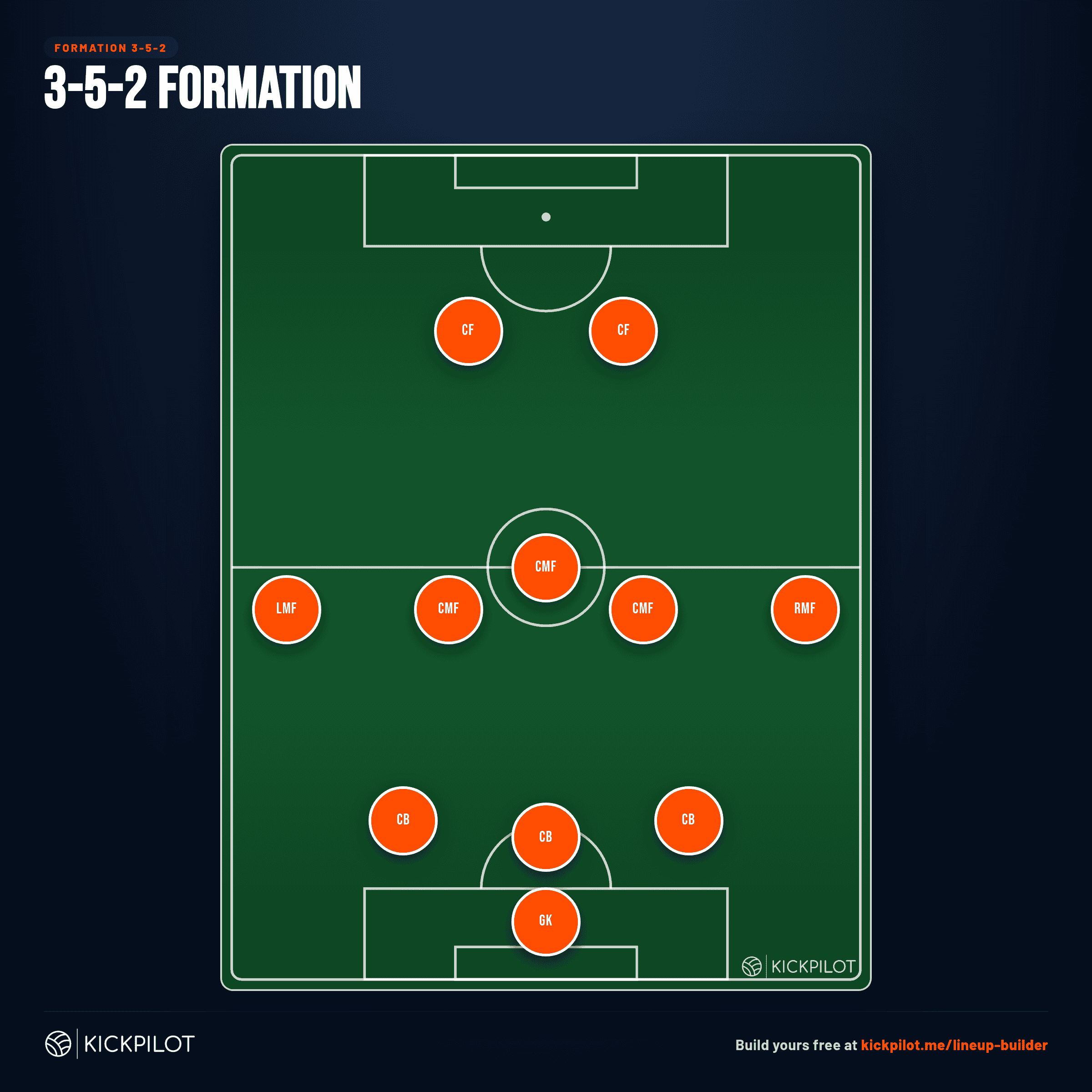
It works best for teams with energetic wing-backs, dependable centre-backs, a disciplined midfield and two forwards who make complementary movements. If you are still comparing systems, read our complete guide to football formations.
How the Football 3-5-2 Formation Changes by Phase
The numbers describe starting positions, not a shape that remains fixed for 90 minutes.
Phase | Typical shape | Main objective |
|---|---|---|
Build-up | 3-2-3-2 | Use the spare defender to progress past the first press |
Attack | 3-2-5 | Stretch the pitch with wing-backs and occupy the box with two strikers |
Defence | 5-3-2 | Protect central areas and force play wide |
High press | 3-4-1-2 | Use two forwards to direct the opponent's build-up |
The system offers strong central numbers, but most of its width comes from only two players. That trade-off creates both its greatest strength and its main risk.
3-5-2 Positions and Player Roles
Goalkeeper and Back Three
The goalkeeper supports build-up and protects the space behind the defence. The central centre-back organises the line, while the two outside centre-backs must be able to defend wider channels when a wing-back advances. At least one defender should be confident carrying the ball or passing through pressure.
Wing-Backs
Wing-backs provide attacking width and complete the back five in defence. They need stamina, timing and sound decision-making. A useful rule is: when one wing-back goes high, the other stays connected enough to protect a counterattack.
Midfield Three
A common triangle has one holding midfielder behind two number eights. The holder screens the defence and supports build-up; the eights connect with the wing-backs and forwards. Against heavy pressure, two midfielders can stay deeper behind a number 10.
Two Strikers
The forwards should make opposite movements: when one drops towards the ball, the other threatens behind. During the press, one applies pressure while the other blocks the next central pass.
When Should You Use the 3-5-2?
The formation is a good fit when:
You have two players capable of repeated wing-back runs.
Three centre-backs can communicate and defend wider spaces.
You want to control midfield or compete better for second balls.
Two forwards offer different movements and qualities.
You want a spare defender against two opposing strikers.
You have enough training time to coach wide rotations and transitions.
It is especially useful when a squad has strong central midfielders and mobile full-backs but no natural wingers.
Avoid forcing the system if your wing-backs cannot recover consistently, your outside centre-backs struggle in wide areas or the team has little time to learn coordinated movements. Dangerous opposition wingers can also pin the wing-backs deep and turn the shape into a passive 5-3-2.
For natural wide forwards, compare the 4-3-3 formation. For a simpler two-striker structure, see the 4-4-2 formation guide.
3-5-2 Formation Tactics in Attack
1. Create a Free Player in Build-Up
Against two pressing forwards, the back three create a 3v2. Find the unmarked defender and progress before the opposition shifts across. If three players press, the goalkeeper or holding midfielder can become the spare player.
2. Use Wing-Backs to Stretch the Pitch
High, wide wing-backs force defenders to choose between protecting the flank and closing central gaps. Even when they do not receive the ball, their positioning can free a number eight or striker inside.
3. Build Wide Triangles
The outside centre-back, number eight and wing-back naturally form a triangle. From there, the team can combine down the line, send the eight beyond a dropping striker or switch quickly to the far wing-back.
4. Protect Against the Counterattack
Keep the holding midfielder and at least one other player connected in front of the back three. The far wing-back should narrow when the attack develops on the opposite side.
3-5-2 Formation Defending Principles
Recover Into a Compact 5-3-2
When the press is not available, the wing-backs drop into the defensive line. The midfield stays narrow and the forwards screen central passes. The units must move together; large gaps beside the holder or between a wing-back and outside centre-back undermine the back five.
Press Wide as a Unit
When the ball travels to an opposition full-back, the ball-side wing-back can step out. The nearest number eight blocks the inside pass, the outside centre-back covers behind and the far wing-back tucks in. This coordinated movement is central to effective defending in the 3-5-2 formation.
Use Clear Pressing Triggers
The first striker curves the press towards one side while the second screens midfield. Good triggers include a backwards pass, a poor first touch, a receiver facing their own goal or a slow pass across the back line. If the midfield cannot follow, the forwards should delay rather than press alone.
Protect the Middle After Losing Possession
The closest player delays the counter, the holding midfielder closes the central lane and the wing-backs recover. The simplest transition rule is: protect the middle first, then recover the width.
Strengths and Weaknesses of the 3-5-2
Strengths | Weaknesses |
|---|---|
Strong central midfield presence | Heavy workload for wing-backs |
Two forwards remain a direct threat | Space can open outside the back three |
Spare defender can support build-up | Wing-backs may be pinned into a back five |
Flexible attacking and defensive shapes | Wide switches test collective movement |
The main weakness is not simply “space out wide.” It is the chain reaction created when the wing-back, outside centre-back and nearest midfielder fail to move together.
Coaching 3-5-2 Tactics: A Simple Progression
Teach the formation in three stages:
Positions and distances: Walk through the base shape without opposition. Check the connections between each wing-back, outside centre-back, midfielder and striker.
Unit relationships: Train build-up with the back three and midfield, then wide defending with the wing-back, number eight and outside centre-back.
Conditioned match: Reward a goal after a switch of play or a regain after forcing the opponent wide. Finish with unrestricted play to see whether the principles remain.
Start with only three rules: find the spare defender in build-up; protect the inside when a wing-back presses; close the centre immediately after losing possession.
For a broader process connecting formations to a game model, read How to Build Winning Football Tactics.
Common 3-5-2 Mistakes and Fixes
Mistake | Practical fix |
|---|---|
Both wing-backs attack without cover | Keep the far wing-back narrow or retain two midfielders behind the ball |
Outside centre-back follows too far | Agree handovers with the holder and wing-back |
Midfield three stand on one line | Create different heights and passing angles |
Both strikers come short | One drops; the other threatens behind |
Team becomes trapped too deep | Keep one forward available and push the line up after clearances |
Before kick-off, every player should know who provides width, who covers behind each wing-back, what triggers the press and where the safe forward outlet is. If those answers are unclear, simplify the plan.
Final Takeaway
The 3-5-2 formation works when its relationships are coached, not when eleven names are simply placed on a diagram. Build around suitable wing-backs, connect the midfield triangle, give the strikers complementary movements and practise the recovery into a 5-3-2.
Once the team can defend the flanks, progress through pressure and protect transitions, the 3-5-2 becomes a flexible system rather than a risky experiment.