How to Create Football Tactics That Win Matches: A Step-by-Step Guide for Coaches

Every coach wants a team with a clear identity. Yet many coaches start in the wrong place. They choose a formation, place players on a tactics board, and hope the system works.
Winning football tactics start with a clear game model. The formation comes later.
The best coaches create football tactics that fit their players. They know how the team will attack, defend, press, and react during transitions.
This guide explains how to create football tactics step by step. You will learn how to assess your squad, choose the right structure, build tactical principles, and turn ideas into training sessions that players understand.
Start With Your Football Philosophy
Before you choose a formation, define how you want your team to play.
Ask yourself:
Do you want to dominate possession?
Do you want to attack quickly after winning the ball?
Do you want to press high up the pitch?
Do you want a compact defensive block?
How much risk will your team take in possession?
Your answers shape every tactical decision that follows.
There is no perfect football philosophy. The best one matches your players.
A youth side with technical midfielders may succeed with patient possession. A team with pace up front may get better results from direct attacks and quick transitions.
Good football tactics fit the squad. They do not copy another team.
Analyse Your Players
Many coaches make the same mistake: they watch elite teams and try to copy their tactics. That rarely works.
Professional teams have players with exceptional technical, physical, and tactical qualities. Most squads do not.
Before you create football tactics, assess your players honestly.
Look at their technical qualities:
Passing
First touch
Finishing
Dribbling
Look at their physical qualities:
Pace
Strength
Stamina
Agility
Look at their tactical qualities:
Positioning
Decision-making
Awareness
Communication
Look at their mentality:
Discipline
Confidence
Leadership
Work rate
Your tactics should highlight strengths and protect weaknesses.
A good tactic fits the players. A great tactic helps players perform beyond expectations.
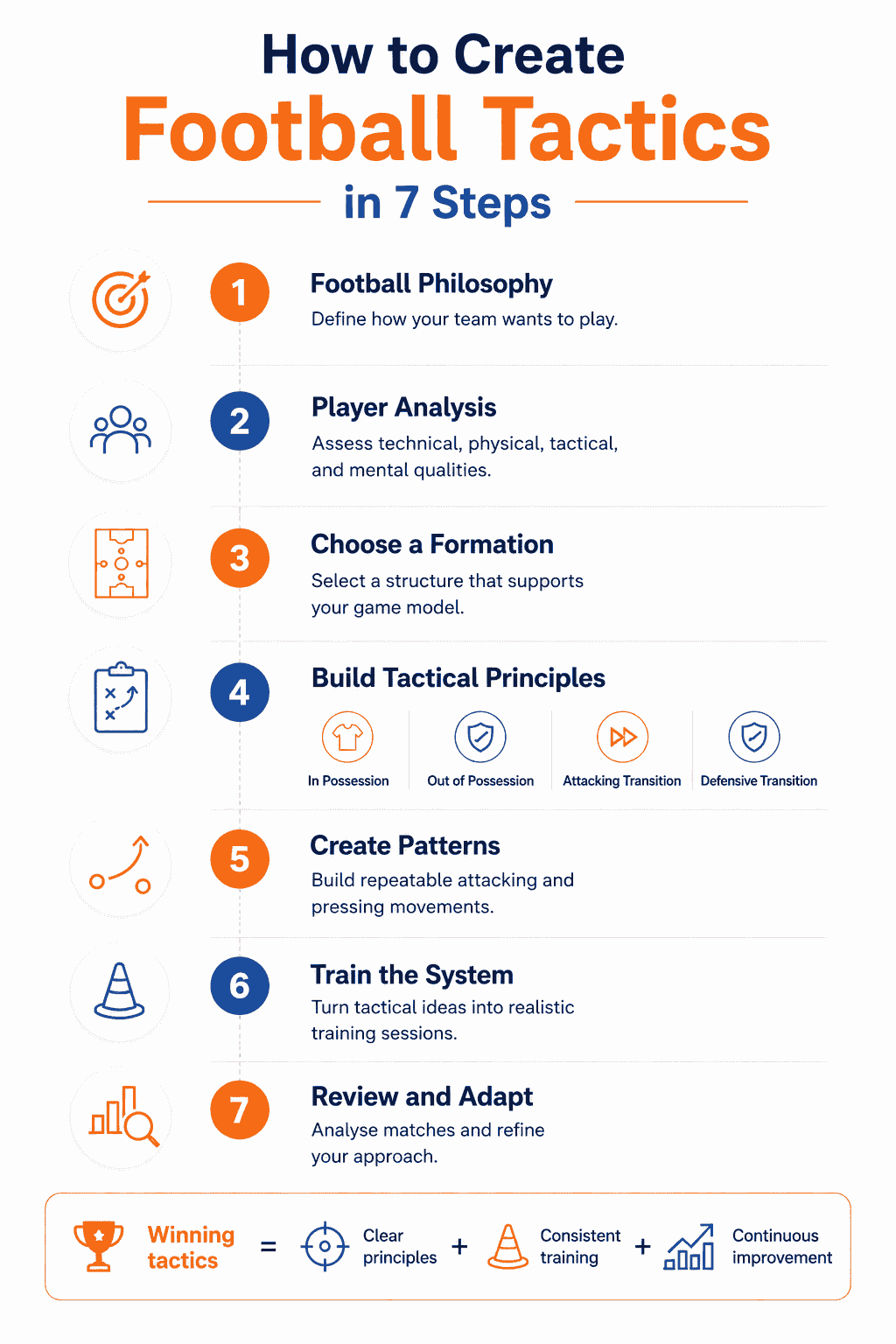
Choose a Formation That Supports Your Ideas
Many people treat formations as tactics, but they are not the same thing.
A formation is simply the starting structure of your team. The same 4-3-3 can support possession football, counter-attacking football, or aggressive pressing. Choose a formation that supports your game model.
4-3-3
This structure works well for:
High pressing
Wide attacks
Positional play
4-2-3-1
This structure works well for:
Balance between attack and defence
Strong central control
Flexible transitions
3-5-2
This structure works well for:
Wing-back involvement
Midfield overloads
Defensive stability
4-4-2
This structure works well for:
Simplicity
Organised defending
Direct attacking football
The formation provides structure. Tactical principles shape behaviour.
Build Tactical Principles for Every Phase of Play
Players need more than positions, they need clear decisions. This is where tactical principles become important. A strong game model gives players guidance in every phase of the match.
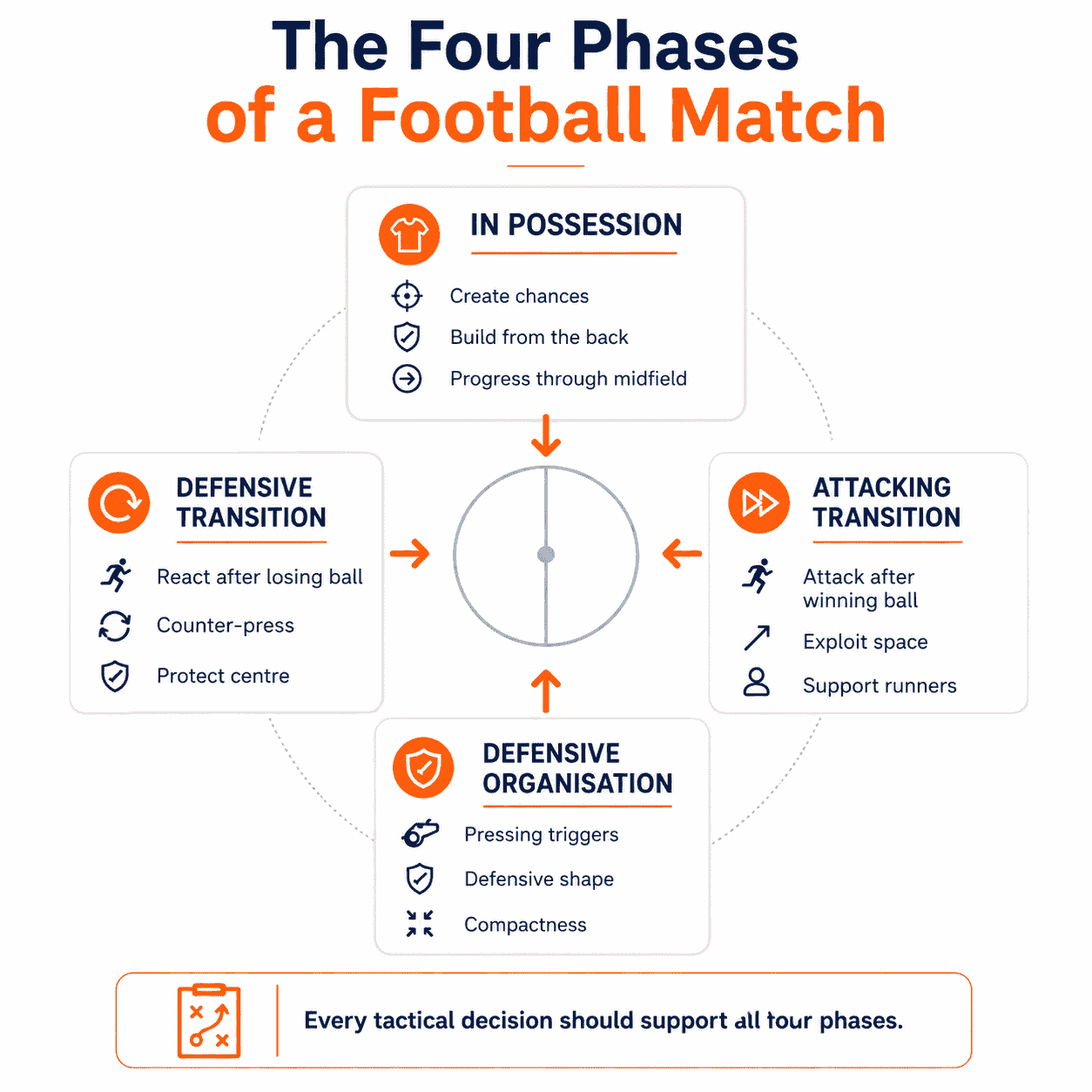
Break the game into four phases.
In Possession
Define how your team will:
Build from the back
Progress through midfield
Create chances
Ask questions such as:
Do centre-backs split wide?
Does a midfielder drop deeper during build-up?
Do wide players stay wide or move inside?
Clear answers create consistency.
Defensive Organisation
Define:
Pressing triggers
Defensive shape
Compactness
Players should understand what happens when the opposition has possession.
Who applies pressure?
Who provides cover?
How does the team protect central areas?
Every player should know the answers.
Attacking Transitions
The moment your team wins possession often creates the best attacking opportunities.
Decide:
Will the team attack immediately?
Will the team secure possession first?
Which players join the attack?
Which spaces should be targeted?
Teams that react quickly often create more dangerous attacks.
Defensive Transitions
Losing possession creates risk. Players need clear instructions.
Will the team counter-press?
Will the team drop into shape?
Which areas need protection first?
The best teams prepare for these moments before they happen.
Create Repeatable Patterns
Players perform better when situations feel familiar. This does not mean making players robotic, it means giving them reliable solutions. Create patterns that appear repeatedly in matches.
An attacking pattern might look like this:
A centre-back passes into midfield.
A midfielder attracts pressure.
A full-back overlaps.
A winger attacks the inside channel.
A pressing pattern might look like this:
The opposition plays backwards.
The striker starts the press.
The midfield pushes forward.
The defensive line squeezes space.
These patterns help players recognise opportunities more quickly.
Turn Tactical Ideas Into Training Sessions
Tactical ideas only matter if players can apply them. Training sessions should connect directly to your game model.
If your team wants to press high, create exercises that involve pressing. If your team wants to build through midfield, create exercises that encourage line-breaking passes and support angles.
A simple session structure works well.
Warm-Up
Introduce movements linked to the tactical theme.
Position-Specific Practice
Work with small groups.
Defenders can practise build-up patterns. Midfielders can practise rotations and support positions. Forwards can practise movement and finishing.
Small-Sided Games
Create situations that force players to use the tactical principles you want to teach.
Match Practice
Finish with realistic game scenarios. Players learn faster when training resembles the match.
Review and Adapt
No tactical system stays perfect: football changes constantly, players improve, opponents adjust, new challenges appear every week.
Review every match carefully. Look at:
Chance creation
Ball progression
Defensive stability
Pressing success
Transition moments
Ask simple questions:
Did the players understand their roles?
Did the tactical principles work?
Which situations caused problems?
What needs to change next week?
Strong coaches treat tactics as a process, not a finished product.
Use Technology to Create Football Tactics Faster
Modern coaches spend less time drawing diagrams by hand. Digital tools make tactical planning faster and clearer.
A football tactics board helps coaches:
Create tactical diagrams
Present match plans
Share ideas with players
Prepare training sessions
The best football coaching software saves time and improves communication.
Players understand tactical ideas more quickly when they can see them clearly.
Final Thoughts
Great football tactics are not the most complicated, they are the easiest for players to understand and execute.
Start with a clear football philosophy, analyse your players honestly, choose a formation that supports your game model.
Build tactical principles for every phase of play, train those principles consistently, review them after every match.
The coaches who achieve long-term success are not searching for the perfect formation. They build a clear system, communicate it effectively, and help players apply it every time they step onto the pitch.
Frequently Asked Questions
How do I create football tactics for my team?
Start by analysing your players. Identify their strengths and weaknesses. Define how you want the team to attack, defend, and transition. Choose a formation that supports those ideas. Then build clear tactical principles and train them consistently.
What is the best formation in football?
There is no single best formation. A 4-3-3, 4-2-3-1, 3-5-2, or 4-4-2 can all be successful. The best formation is the one that suits your players and supports your game model.
What is the difference between a football tactic and a formation?
A formation describes the team's starting structure on the pitch. A tactic explains how the team plays. Two teams can use the same formation and have completely different tactical approaches.
How often should coaches change their tactics?
Coaches should review tactics regularly. Small adjustments often work better than major changes. Tactical principles should remain consistent, but match plans can change based on the opponent and available players.
What are tactical principles in football?
Tactical principles are rules that guide player decisions during a match. They cover behaviour in possession, defensive organisation, attacking transitions, and defensive transitions. Strong principles help players react quickly in different situations.
How can I improve my team's tactical understanding?
Use simple language, visual examples, and realistic training exercises. Repeat key principles throughout the season. Players learn faster when training activities reflect situations they face in matches.
What is a game model in football coaching?
A game model describes how a team plays in every phase of the game. It includes attacking patterns, defensive behaviour, pressing strategies, transition principles, and player roles. The game model acts as the foundation of the team's tactical identity.
What software can coaches use to create football tactics?
Many coaches use football tactics boards and coaching software to create formations, tactical diagrams, training sessions, and match plans. Digital tools help coaches organise ideas and communicate them clearly to players and staff.
How do professional coaches create football tactics?
Professional coaches start with a game model. They analyse player profiles, define tactical principles, study opponents, and build training sessions around their tactical objectives. Every part of the coaching process supports the team's playing style.
Why are transitions important in football tactics?
Many goals are scored within a few seconds of winning or losing possession. Teams that react quickly during transitions can create chances, recover the ball faster, and control matches more effectively.