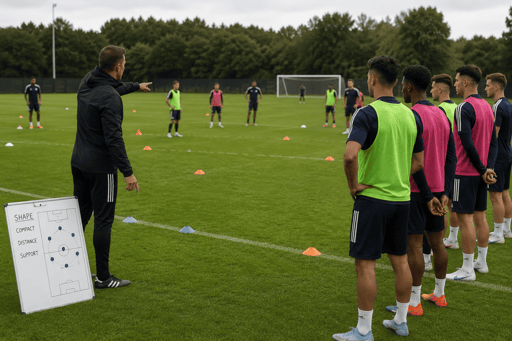
Attacking vs Defensive Football Strategies: Which Playstyle Actually Wins More Matches?
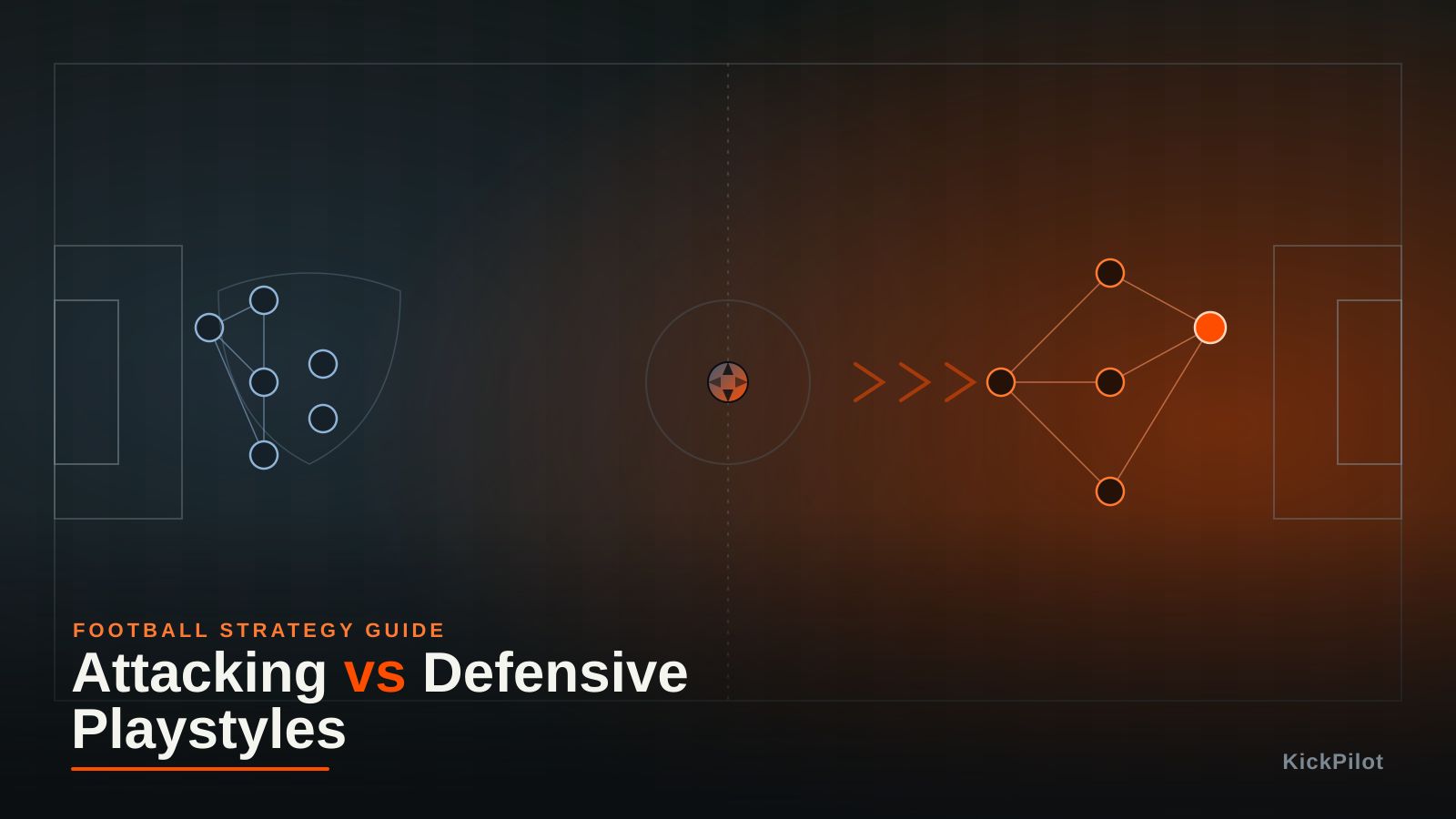
⏱ 11 min read 📋 comparison framework + decision checklist
Every coach eventually has to answer the same question, usually right after a frustrating result: do we go and win the game, or do we make sure we don't lose it? That single decision — attack or defend — shapes everything else: your formation, your training sessions, your substitutions, even how you recruit players.
This isn't a debate with one correct answer. It's a trade-off, and the right side of it depends on your squad, your opponent, and what "winning" means for your team this season. This guide puts football attacking tactics and defensive football strategies side by side, with the data behind each approach, so you can make that call with more than just gut feeling.
If you want the full breakdown of formations and systems first, our complete guide to football tactics covers the 4-3-3, 4-2-3-1, 3-5-2, and 4-4-2 in depth. This article builds on that and focuses specifically on the attacking-versus-defensive decision.
Quick Answer: Attacking vs Defensive, in One Table
Attacking Playstyle | Defensive Playstyle | |
Core idea | Control the game by controlling the ball and the opponent's half | Control the game by controlling space and denying the opponent's plan |
Typical shape | 4-3-3, 3-4-3, high pressing lines | 4-4-2, 5-3-2, mid or low block |
Best for | Technically strong, fit squads with confident ball-players | Well-organised squads, weaker technical level, or facing a stronger opponent |
Biggest risk | Getting caught in transition when possession is lost | Struggling to create enough chances actually to win |
Data signal | Higher xG and territory, but not always more goals | Fewer chances conceded, but wins often hinge on one moment |
Neither column is "correct" in isolation. What research consistently shows — and we'll get into the specifics below — is that the winning ingredient is rarely the raw style itself, but how well a team executes the one it chooses.
What Actually Separates an Attacking Team From a Defensive One
It's tempting to define this by formation, but that's a trap. A 4-4-2 can press aggressively and dominate the ball, and a 4-3-3 can sit deep and break at pace. The real dividing lines are:
Where the team wants to win the ball — high up the pitch (attacking) vs deep in their own half (defensive)
How much risk it accepts in possession — line-breaking passes and third-man runs vs safe, low-turnover circulation
What happens without the ball — an aggressive press that invites chaos vs a compact block that removes space
This is exactly the distinction our guide on how to create football tactics starts with: define your football philosophy before you touch a formation. Attacking vs defensive is a philosophy decision, not a formation decision.
Football Attacking Tactics: How They Work and Where They Break Down
An attacking playstyle is built around three things: high pressing, quick vertical progression, and committing numbers forward. Teams like Manchester City and Bayern Munich have made this look inevitable, but at grassroots and semi-pro level, it's a much higher-wire act.
What attacking tactics look like in practice:
A high defensive line that squeezes the pitch and shortens the distance the team needs to cover
Full-backs or wing-backs pushing high to create width and overloads
Central midfielders taking risks with forward passes rather than recycling possession sideways
Immediate counter-pressing (gegenpressing) the moment the ball is lost, to stop the opponent from breaking out
Where it pays off: Recent crossing data from UEFA's own 2024/25 club competition technical reports show just how much conversion efficiency varies even among elite attacking sides — in that Champions League season, Paris Saint-Germain scored roughly one goal for every 94 crosses, while Real Madrid needed around 159 crosses per goal, despite both being high-volume attacking teams. The same reports found Atlético Madrid building their identity around controlling wide areas from a mid and low block, while Manchester City led the field in converting goal kicks into final-third entries. The takeaway: attacking output isn't just about creating chances; it's about which specific attacking pattern your squad can execute efficiently.
Where it breaks down: Academic research analysing playing styles in the Champions League and other top leagues has repeatedly found that possession-heavy teams often dominate the ball but struggle to convert sustained control into high-quality chances, especially against well-organised, compact defences (see this 2025 study on data-driven playing style classification). In other words, dominating the ball is not the same as dominating the scoreboard. If your squad presses high but lacks the pace or discipline to recover when it's bypassed, an attacking approach can concede exactly the kind of one-on-one moments a defensive team is built to avoid.
Defensive Football Strategies: How They Work and Where They Break Down
A defensive playstyle isn't the absence of a plan; it's a different plan, built around compactness, patience, and picking your moments. Done well, it's one of the hardest styles to break down; done badly, it's just "parking the bus" and hoping.
What defensive strategies look like in practice:
A mid or low block that keeps the two banks of four (or five) narrow and close together
Clear pressing triggers — the team only presses when the ball goes into specific zones, rather than chasing it everywhere
A back line that prioritises cover and communication over stepping up aggressively
Fast, direct transitions the moment the ball is won, since a compact block naturally sets up counter-attacks
Where it pays off: This is where the data gets genuinely interesting. A comparative study of Euro 2024 and Copa America 2024 found that teams favouring possession-based styles and teams favouring direct, transition-based styles both produced strong results, but required completely different training priorities — direct teams built around rapid ball progression, vertical passing, and high-intensity counter-attack simulations rather than patient buildup. Separately, the same 2025 study on data-driven playing style classification cited above found that counter-attacking teams often succeed not simply by defending deep, but by turning defensive actions into purposeful transitions that exploit the space an attacking opponent leaves behind.
That last point matters for grassroots and youth coaches especially. Even a technically limited squad can be genuinely competitive with a well-drilled defensive strategy, because the system does more of the work than individual quality.
Where it breaks down: A defensive strategy lives and dies by discipline. One player stepping out of the block, one mistimed press, and the entire structure that made the team hard to beat becomes the reason they concede. It also puts enormous pressure on a small number of attacking moments — if your two strikers have a quiet day, a low block with no attacking outlet can produce a result nobody's happy with, even a 0-0.
Attacking vs Defensive: What the Research Actually Says
It's worth being precise here, because a lot of football content treats this as a simple "which is better" question when the research says something more useful: style matters less than fit and execution.
A few findings worth knowing:
A 2025 observational study of the UEFA Youth League found that organised attacks generated more scoring opportunities than counter-attacks overall, yet winning teams were more likely to have used counter-attacking strategies in those same matches — a reminder that "creates more chances" and "wins more often" aren't the same measurement.
Physical demands differ sharply by style. Research on Bundesliga tracking data examining possession-based versus counter-attacking approaches found meaningful differences in the physical and technical demands each style places on players, which has direct implications for squad fitness planning and rotation.
Set pieces remain a leveller regardless of style. UEFA's own competition reports have repeatedly flagged how much of the goal difference in knockout football comes down to dead-ball execution rather than open-play dominance, which is exactly why our football tactics guide treats set-piece work as a near-universal priority.
The practical implication: don't pick a playstyle because it looks more "modern" or more exciting on paper. Pick it because it matches what your players can actually execute under pressure, and back it up with the phase of play most teams neglect — set pieces and transitions — regardless of which side of the attack/defence line you sit on.
How to Choose the Right Playstyle for Your Team
Use this as a working checklist rather than a formula. None of these questions has a universally "correct" answer; they're meant to expose where your squad's real strengths lie.
What's your players' technical ceiling under pressure? Attacking, possession-heavy systems demand comfort on the ball in tight spaces. If players under pressure regularly break down in training, a more direct or defensive approach will produce better results faster.
What's your squad's fitness and recovery profile? High pressing and counter-pressing are physically brutal, especially over a full season. Teams without strong conditioning tend to fade in the press during the second half.
What does the opponent do well? Attacking tactics that work against a disorganised low block often fail against a team that presses aggressively, and vice versa. This is exactly the kind of detail our guide on how to analyse football matches walks through step by step.
What result do you actually need? A cup knockout tie away from home often calls for a different balance than a home league game you're expected to win. Adjusting a game plan for the occasion isn't indecisive, it's tactical maturity.
Can your players execute the defensive transition, whichever style you choose? Attacking teams need a plan for the moment they lose the ball. Defensive teams need a plan for the moment they win it. Both transitions matter more than the label you put on your system.
Hybrid Systems: Why Most Elite Teams Don't Pick One Side
In practice, very few top teams are purely attacking or purely defensive across 90 minutes. The most common pattern in modern football is a team that defends in a compact, defensive-minded shape and attacks with a completely different, expansive structure once possession is won. For example, a 4-4-2 defensive block that builds into a 3-2-5 attacking shape.
This hybrid approach is worth training deliberately rather than leaving to instinct:
Define the defensive shape your team drops into out of possession
Define the attacking shape your team pushes into once it has the ball
Drill the transition moments between the two — these are where matches are actually decided, and where our guide on analysing football matches recommends spending the most video review time
Youth and grassroots teams often skip this step because it feels advanced, but the opposite is true — a simple, clearly defined hybrid shape is usually easier for younger players to understand than a purely attacking system that asks everyone to take risks all the time.
Common Mistakes Coaches Make When Choosing a Playstyle
Copying a style because a top team uses it, without the players or fitness level to support it. A possession-based approach built for a technically elite academy squad can fall apart with a recreational adult team.
Switching styles too often. Players need repetition to internalise pressing triggers or buildup patterns. Changing the game model every few weeks prevents anything from becoming automatic.
Ignoring transitions. Whichever style you choose, the moments immediately after winning or losing the ball are where most goals are scored and conceded — not the settled phases of play.
Treating set pieces as an afterthought. Regardless of playstyle, dead-ball situations are one of the most reliable ways to add goals without changing your entire tactical identity.
Never reviewing the plan against actual match footage. A playstyle is a hypothesis until you've checked it against what actually happened on the pitch.
Final Thoughts
Attacking and defensive football strategies aren't rival philosophies competing for the title of "best football strategies" — they're tools that solve different problems. An attacking approach solves the problem of creating enough chances to win comfortably. A defensive approach solves the problem of not giving weaker moments enough space to become goals against you.
The teams that get the most out of either approach are rarely the ones with the most talented players. They're the ones whose coach picked the style that actually matched the squad, drilled it relentlessly, and paid just as much attention to the boring parts — transitions and set pieces — as to the exciting ones.