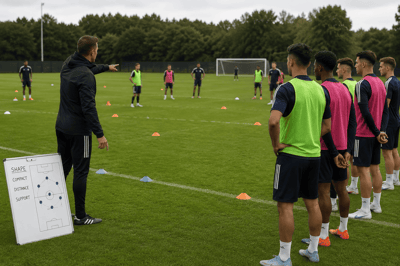
Football Coach Skills and Qualities: What It Takes to Succeed

Tactics get most of the attention, but ask any experienced coach what actually decides whether a season goes well, and few will start with a formation. They'll talk about how they read a dressing room, how they handle a frustrated parent, or how they get a flat group of nine-year-olds fired up again on a wet Tuesday evening.
That's because football coach skills aren't really one skill at all. They're a combination of tactical know-how, people management, and teaching ability, and the balance between them shifts depending on who you're coaching. A great academy coach and a great Sunday league manager don't need identical skill sets, but the best coaches at every level share a recognisable core of habits and traits.
This guide breaks down the football coach skills and qualities that matter most, the skills needed at different levels of the game, and practical ways to build them if you're just starting out.
What Are Football Coach Skills, Exactly?
Football coach skills generally fall into three buckets:
Technical and tactical skills - understanding the game itself: formations, pressing triggers, set pieces, individual technique, and how to coach them.
People and leadership skills - communication, motivation, conflict resolution, and the ability to build trust with players, parents, and staff.
Organisational skills - planning sessions, managing schedules, tracking attendance and player development, and keeping a squad running smoothly off the pitch.
Most coaching courses focus heavily on the first bucket. In practice, the second and third often determine whether a coach actually gets the chance to apply their tactical knowledge in the first place. A coach who knows football inside out but can't hold a group's attention, or who burns out under admin, will struggle regardless of how good their sessions look on paper.
Core Qualities of Successful Football Coaches
Communication
The single most cited quality among successful coaches is the ability to communicate clearly and adapt that communication to the audience. Instructions that work for a senior amateur side will go straight over the heads of a U10 group. Good coaches simplify without dumbing down, use demonstrations alongside words, and check that messages have actually landed rather than assuming they have.
Leadership and Authority
Leadership isn't about shouting the loudest. It's about consistency: players need to know what's expected of them, what the standards are, and that those standards apply to everyone. Coaches who lead well tend to make decisions calmly, own their mistakes, and earn respect through behaviour rather than demanding it through position.
Tactical and Technical Knowledge
This is the part most people associate with coaching, and it still matters. Understanding formations, game models, and individual technique allows a coach to diagnose problems accurately and set training that actually fixes them, rather than running generic drills because they look good on a whiteboard.
Adaptability
No two seasons, squads, or matches go exactly to plan. Injuries pile up, a tactical setup that worked last week gets picked apart this week, and a star player gets a bad case of nerves. Coaches who succeed long-term are the ones who adjust quickly rather than forcing a plan that isn't working.
Patience
Particularly in youth and grassroots football, progress is rarely linear. A skill drilled for weeks might not show up in a match for months. Coaches with patience keep faith with the process and avoid overreacting to a single bad result or a player's slow start.
Organisation
Even the most tactically gifted coach struggles if training is disorganised, communication is patchy, or nobody knows the match time. Organisational skill - planning sessions in advance, keeping clear records, and running a tidy operation - frees up mental space for actual coaching.
Emotional Intelligence
Reading the mood of a group, knowing when to push and when to ease off, and managing personal relationships with players (and their parents) all fall under emotional intelligence. It's frequently the difference between a coach who gets the best out of a talented but difficult player and one who loses them entirely.
Passion and Self-Motivation
Coaching, especially at the grassroots level, is often unpaid or underpaid, and the hours are long. The coaches who stick with it and keep improving tend to genuinely love the process. Not just match day, but the planning, the small improvements, and the slow building of a team culture.
Skill Category | Examples | Why It Matters |
Communication | Clear instructions, active listening, and feedback | Players actually understand and apply coaching points |
Leadership | Consistency, accountability, calm decision-making | Builds trust and respect within the squad |
Tactical knowledge | Formations, game models, and technical coaching points | Sessions target real problems, not guesswork |
Adaptability | In-game adjustments, handling setbacks | Keeps the team competitive when plans change |
Organisation | Session planning, scheduling, and record-keeping | Reduces admin chaos and wasted training time |
Emotional intelligence | Reading player mood, managing conflict | Keeps individuals engaged and the group cohesive |
Football Coach Skills Needed at Different Levels
The skills needed shift depending on who's in front of you.
Grassroots and youth coaching leans heavily on teaching ability, patience, and communication. At this level, development matters more than results, and a coach's main job is making the game enjoyable enough that kids keep showing up while gradually building technical foundations.
Club and academy coaching adds a layer of structured player development planning: tracking progress against an age-appropriate curriculum, working closely with other coaches across age groups, and balancing individual development with team results.
Semi-professional and adult amateur coaching shifts the weighting toward tactical preparation, man-management of adults with jobs and varying commitment levels, and squad rotation across a long season.
Across all three, the organisational skills needed scale up rather than disappear. A coach running three age groups inside a club needs far more structure around scheduling, communication, and record-keeping than someone managing a single Sunday team, even if the on-pitch coaching style is similar.
Football Teaching Skills: Helping Players Actually Improve
Coaching and teaching aren't identical, but the overlap is significant, particularly at the youth level, where a coach is often a player's first introduction to structured learning in any setting.
Strong football teaching skills include:
Breaking a complex skill into smaller, learnable steps rather than expecting players to absorb it whole.
Using demonstration, not just explanation, since most players learn technique visually and physically before they learn it verbally.
Giving feedback that's specific and actionable ("plant your foot closer to the ball before you strike it") rather than vague ("better!" or "try harder").
Creating repetition through game-realistic practice, so skills transfer to actual matches instead of staying isolated in drills.
Differentiating instruction for players at different skill levels within the same session, rather than coaching the middle of the group.
Coaches who treat themselves as teachers first, rather than just instructors barking corrections from the sideline, tend to see faster, more consistent improvement across a squad.
Skills to Be a Football Coach: How to Start Building Them
If you're newer to coaching, the skill set above can feel like a lot at once. A few practical starting points:
Get qualified. National federation coaching courses (in England, the FA's Level 1 and Level 2; equivalents exist almost everywhere) teach the tactical and technical foundations and give structured, low-stakes practice at delivering sessions.
Watch other coaches. Sitting in on sessions run by more experienced coaches, even at a different age group or level, exposes you to communication styles and session structures you wouldn't think of on your own.
Start small and reflect honestly. Coach a single session, then ask what landed and what didn't. The gap between a planned session and how it actually plays out is where most early learning happens.
Find a mentor. A more experienced coach willing to give honest feedback is worth more than most courses, particularly for the people-management side of the job that's hard to teach in a classroom.
Get the admin off your plate early. New coaches often lose enthusiasm not because of the coaching itself, but because of the unglamorous workload around it. Chasing payments, tracking who's coming to training, and repeating the same updates across three different group chats.
Common Mistakes Even Good Coaches Make
Coaching the way they were coached, without question. Methods from twenty years ago aren't automatically wrong, but they're worth re-examining rather than copying blindly.
Over-focusing on results at the expense of development, particularly in youth football, where short-term wins can come at the cost of long-term player growth.
Treating every player identically, rather than adjusting communication and challenge level to the individual in front of them.
Letting admin eat into coaching time and energy, until session planning becomes an afterthought squeezed in five minutes before training.
Avoiding difficult conversations with players or parents, which tends to make small issues larger over time.
A Quick Checklist: Skills for a Football Coach
Clear, age-appropriate communication
Calm, consistent leadership
Solid tactical and technical foundation
Ability to adapt plans in real time
Patience with gradual, non-linear progress
Strong session and squad organisation
Emotional intelligence with players and parents
Genuine motivation to keep learning the craft
No coach arrives with all of these fully formed. They're built over seasons, usually through a mix of formal courses, mentorship, and simply coaching enough sessions to learn what actually works.
How the Right Tools Free Up Time to Coach
A lot of the qualities above - patience, communication, the energy to keep teaching well - are hard to maintain when a coach is also doing the work of a club secretary, accountant, and group chat moderator in their spare time. Tracking who's paid their subs, confirming who's available for Saturday, and keeping player records straight all take time that could otherwise go into planning better sessions.
This is where a tool like KickPilot helps. It centralises lineups, attendance, payments, and player records in one place, so coaches spend less time chasing information across spreadsheets and group chats, and more time on the part of the job that actually develops players.
Conclusion
Tactical knowledge gets a coach started, but the football coach's skills and qualities that keep players developing and squads functioning long-term are mostly about communication, leadership, teaching ability, and organisation. The good news is that none of these are fixed traits, they're skills, and like any skill, they improve with deliberate practice, honest reflection, and time spent actually coaching.